Panduit: Worst Case in Grey Space
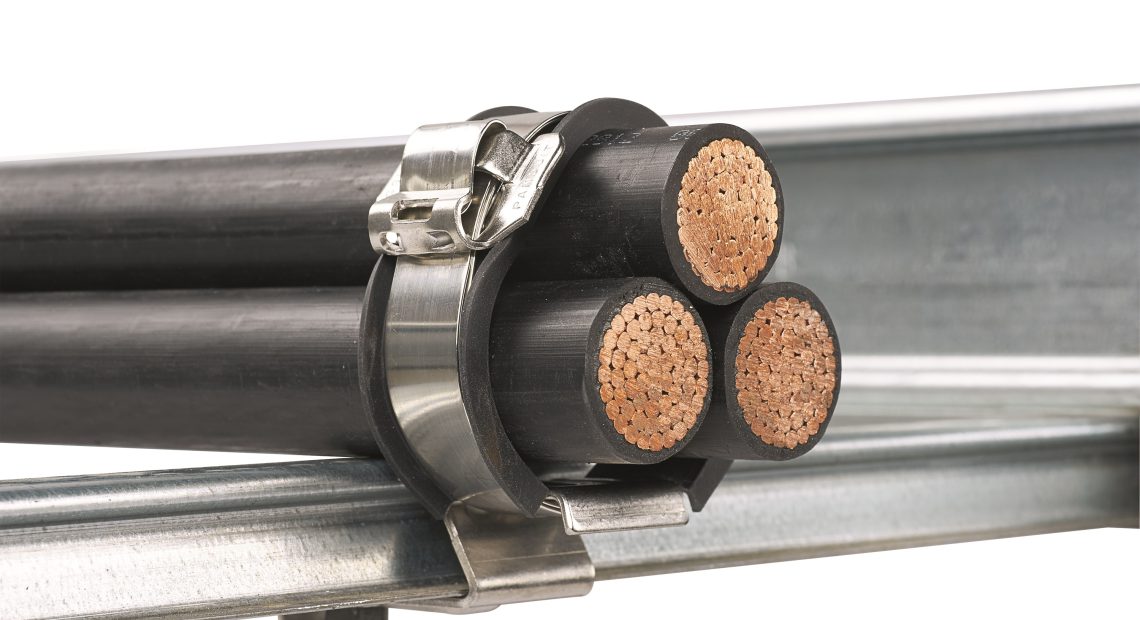
As data center workloads and power demands grow, short circuits can generate extreme forces within milliseconds. Panduit’s cable restraint solutions, developed and tested according to IEC 61914:2021, help protect infrastructure, personnel and operational continuity
By: Martin Kandziora, Senior Manager Marketing EMEA, Panduit GmbH
E-mail: Martin.Kandziora@panduit.com
On the one hand, the amount of data to be processed in data centers is constantly increasing, while power consumption is also rising due to higher performance. A reliable power supply is crucial for the reliability of data centers and buildings. A failure is not necessarily caused by the user or the power supply. The path from the generator to the system poses risks that should be considered to ensure a reliable power supply. Short circuits are critical for data center availability even after the actual event. Standard-compliant measures for cable installation in the grey space of the data center offer more security and investment protection.
Growing loads increase risk

Standard-compliant measures for cable installation in the grey space of the data center offer more security and investment protection.
The electrical short circuit leads to a massively increased current flow through low and medium-voltage cables in just a few milliseconds. The current strength can be up to 200,000 A in such events. The significant current flow and the resulting increased magnetic field around the cable create dynamic forces due to the interaction of 50 Hz. As a result, the cables are made to vibrate. In the worst case of a three-phase short circuit, the magnetic field-induced impact forces between the cables can be up to 45,000 Newtons and develop within 1/100 of a second. Considerable damage can occur before the circuit breakers can trip on the short circuit. As a result, cable restraint is crucial for protecting personnel and infrastructure and reducing downtime.
Containing the forces
Such dynamic forces are absorbed by the cable clamps and the associated cable support system. The cable clamps, which are attached to the support system, prevent individual cables from being torn loose by vibrations and from damaging the electrical installation throughout the data center. Unfortunately, in both new and existing data centers, quick but inadequate cable fastening solutions are still sometimes used. The worst-case scenarios are hard to imagine. Yet it is relatively easy to implement a professional, safe installation solution.
Designing and testing for short-circuit events
Current-carrying cables in data centers can be laid and secured in different ways. As a structural-mechanical solution, for example, the new cable clamps from Panduit protect against short circuits, thereby significantly increasing overall data center safety.
IEC 61914:2021 Edition 3 very precisely documents the test setup that simulates the resistance to electromechanical forces and how the forces on cables and cable holders can be calculated. Panduit’s research and development department uses a modern simulation program to identify how the electromagnetic forces develop in the event of a short circuit and which material composition of the cable clamps is suitable. The virtual observation is ideal preparation for the test in accordance with IEC 61914:2021 Ed. 3. Only after the simulation on the computer are the components subjected to real short-circuit tests in a certified laboratory to confirm that they comply with this standard. Panduit’s research and development engineers use modern simulation software to model the dynamic 3-phase AC short-circuit test. The virtual test takes place over a period of 0.1 seconds.
The newly developed Panduit cable clamp product lines are tested for short-circuit resistance by the Damstra Lab testing institute in the Netherlands. The peak values of the short-circuit current are very close to those of the simulation.
Overall, Panduit’s research and development department was able to identify the variables involved in the three-phase short circuit more quickly and accurately. Repeated simulations verified design changes and determined peak current certification levels. In summary, the prototype and test cycle was significantly reduced.
The simulation and real tests underscore the fundamental importance of short-circuit-proof fastening for live low- and medium-voltage cables. The IEC defines the cable clamp as a component that secures cables at fixed intervals along their length. In other words, the aim is to absorb static and dynamic forces and hold the power lines firmly in place. In addition, the cables should remain undamaged in the event of a short circuit so that the entire system can be switched back on and continue to be used.
Meeting IEC 61914 requirements
IEC standard 61914:2021 Edition 3 plays a special role in the development of Panduit cable clamps. The standard with the addition “2021 Ed. 3” is the current, most comprehensive and globally recognized requirement for testing cable clamps. Founded in 1955, the American family-owned company meets these stringent requirements so that the cable clamps can safely withstand enormous mechanical forces in the event of a short circuit.
In detail: The greatest load during short circuits occurs up to 0.005 seconds before circuit breakers and other protective devices are tripped. The new cable clamps fix cable bundles and ensure that cables remain securely fastened and in place in the event of a short circuit. This provides the best possible protection for the working environment, including equipment and employees, and prevents downtime.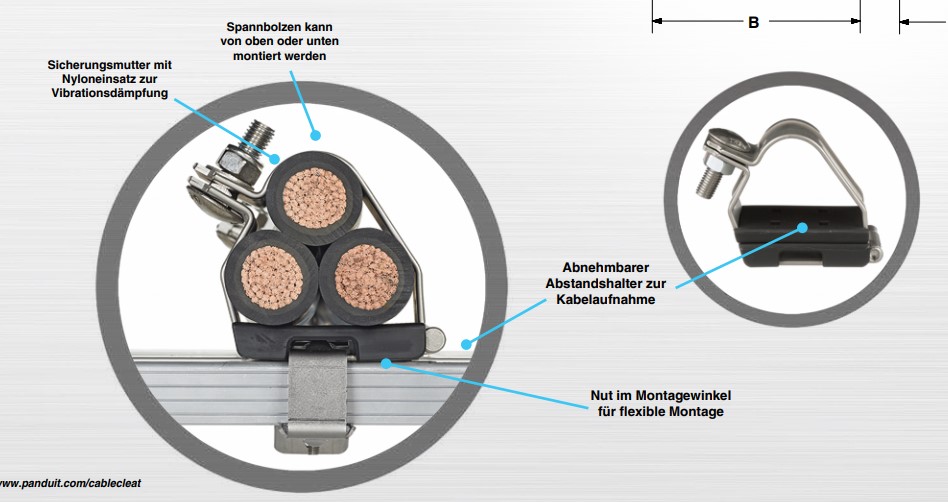
Cable clamp solutions for critical infrastructure
The new cable clamps from Panduit vary in size, design, and materials and are suitable for a wide range of applications in process plants, information technology, and industrial manufacturing. The materials available for the various applications include aluminum, plastic and the highly corrosion-resistant, dual-certified stainless steel 316/316L. The stainless steel cable clamps have rounded, folded edges to prevent damage to the cables. The buckle has its own cable holder and can accommodate cables in quad and cloverleaf formations as well as multi-core cables. Once the cables have been laid, the cable clamp can be attached using a mounting bracket that is unique in the industry.
The bracket can be tensioned and cut to length using a hand-operated ratchet installation tool or a tool for tightening a tensioning screw. The straps are often used with a damping sleeve inserted between the strap and the cable for added protection. A plastic buckle is also available for the stainless steel cable ties, as well as various fixing brackets. For example, stainless steel cable clamps are available for cable diameters of 12 to 86 mm in widths of 12.7 to 19.1 mm for short-circuit currents of 45 to 188 kA. Of course, professional tools for quick and professional installation are also available.