Linev Systems: AI-Driven Multi-Energy X-Ray Inspection Technology
Across the Middle East, cargo security is undergoing a structural transformation. Trade volumes continue to grow as new ports, logistics corridors, and border infrastructures expand under national development strategies. At the same time, the nature of security risks has evolved. Modern threats are smaller, more modular, and increasingly designed to exploit the limitations of conventional inspection systems
By: Igor Bondarev, Director, LINEV Systems
E-mail: bondarev@linevsystems.com
Authorities today are concerned not only with traditional smuggling, but also with concealed drone components, military-grade electronics, modular weapon assemblies, counterfeit industrial systems, and dual-use technologies embedded within legitimate shipments. These items are often distributed throughout cargo, shielded by dense materials, or positioned to reduce detectability.
In this environment, inspection technology must do more than produce high-contrast images. It must generate reliable intelligence under operational pressure.
The Structural Limitation of Conventional Approaches
Most cargo inspection systems historically improved performance along one of two axes: penetration power or viewing geometry. High-energy systems were developed to see through dense cargo, while Dual-View architectures were introduced to eliminate geometric blind zones.
While both approaches represent meaningful progress, they typically operate as separate enhancements. Increased energy improves penetration but does not necessarily resolve material ambiguity. Additional viewing angles reduce certain blind spots, yet complex shielding and layered cargo configurations can still obscure critical details.
Modern concealment techniques often exploit this separation precisely. An object that is partially masked in one projection may remain indistinct if energy parameters are not optimized. Conversely, a high-energy scan alone may penetrate deeply but fail to provide the material contrast required for confident classification. Addressing these limitations requires not incremental upgrades, but coordinated system design.
Multi-Energy Array as a Coordinated Architecture
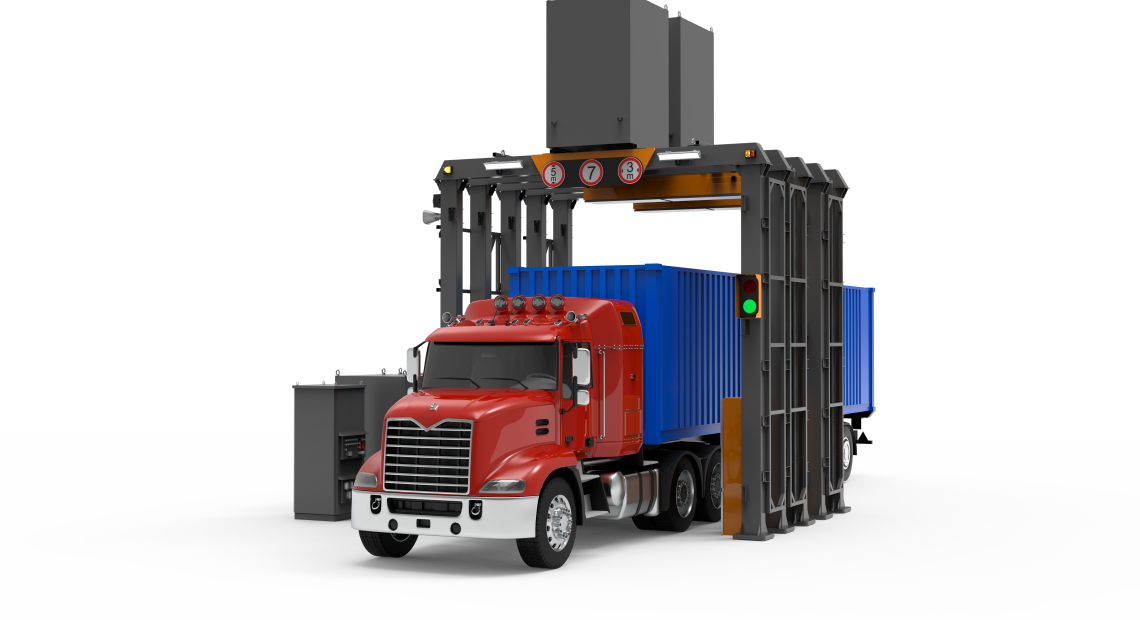
The Multi-Energy X-Ray Array Portal (MEAP) was engineered to integrate geometry and energy into a unified inspection architecture. Instead of alternating between energy levels or relying solely on increased penetration, MEAP employs synchronized, geometrically aligned sources operating at different energies. The resulting data is fused into a single, information-rich inspection output.
This simultaneous multi-energy irradiation allows the system to analyze how materials behave across energy levels while being viewed from multiple projections. A structure that appears ambiguous at one energy may reveal distinctive characteristics at another. An object partially obscured in one projection can be better understood when evaluated using fused energy data from a complementary angle.
By coordinating energy diversity with multi-view acquisition, MEAP moves beyond simple imaging toward enhanced material interpretation. The interaction between geometry and energy becomes an active detection tool rather than a passive visual aid.
AI as the Foundational Layer
Another distinguishing feature of the MEAP platform is its development philosophy. In many inspection systems, artificial intelligence is introduced after the hardware architecture has been finalized. In the case of MEAP, the analytical core was defined first, and hardware parameters were optimized to supply the AI engine with the most stable and information-dense data possible.
Detector configuration, energy synchronization, and acquisition timing were designed to support high-confidence algorithmic analysis. As a result, the AI system does not merely assist operators by flagging suspicious shapes; it evaluates material response across fused energy layers and correlates multi-view projections in real time.
This approach enhances detection reliability while reducing unnecessary alarms. Operators benefit from more consistent analytical support, particularly in high-throughput environments where cognitive fatigue can compromise performance. Rather than replacing human expertise, the system reinforces it with structured, data-driven insight.
Addressing Contemporary Threat Profiles
The current security landscape in the region includes risks that extend beyond conventional contraband. Authorities are increasingly focused on preventing the unauthorized movement of drone platforms, embedded military electronics, precision components, and dual-use technologies that may be concealed within otherwise legitimate cargo flows.
These items are often compact and deliberately engineered to blend with standard industrial materials. MEAP’s multi-energy fusion capability enhances the differentiation between organic, inorganic, and metallic signatures, even within dense or layered shipments. When combined with synchronized Dual-View geometry and AI-based anomaly detection, this enables greater analytical confidence. In strategic trade environments where missed detection can affect national stability and public safety, such a coordinated detection architecture becomes critical.
Designed for Scalable Regional Infrastructure
The Middle East continues to invest heavily in smart ports, modernized border checkpoints, and integrated logistics zones. Inspection systems must therefore combine performance with long-term adaptability. MEAP’s modular configuration allows deployment across a range of operational environments, from compact checkpoint installations to large-scale port infrastructures. As throughput demands increase or threat models evolve, system capabilities can be expanded within the same architectural framework. This scalability ensures that inspection infrastructure remains aligned with both economic growth and evolving security priorities.
From Imaging to Intelligence
Cargo inspection has historically focused on producing clearer images. The next stage of evolution lies in transforming those images into structured intelligence. By integrating synchronized multi-energy sources, coordinated viewing geometry, and an AI-centered analytical core, MEAP represents a shift toward inspection systems designed to interpret—not merely visualize—cargo content.
In an era where threats are engineered to avoid detection, inspection technologies must be engineered with equal sophistication. For regions positioned at the crossroads of global trade, the ability to understand cargo in real time is not simply an operational advantage. It is a strategic necessity.
For more detailed information, please visit https://multienergyportal.com/.