Scaling Fire Safety for Phased Giga-Developments
Across the Middle East, major developments are rarely delivered as a single, fixed project. Instead, they evolve in stages, with new buildings, infrastructure, and services added over time. This phased delivery model creates flexibility for developers, but it also places new demands on fire detection and alarm systems.
By: Sargunan Sellamuthu, Business Development Manager – Middle East, Advanced
E-mail: ssellamuthu@advancedco.com
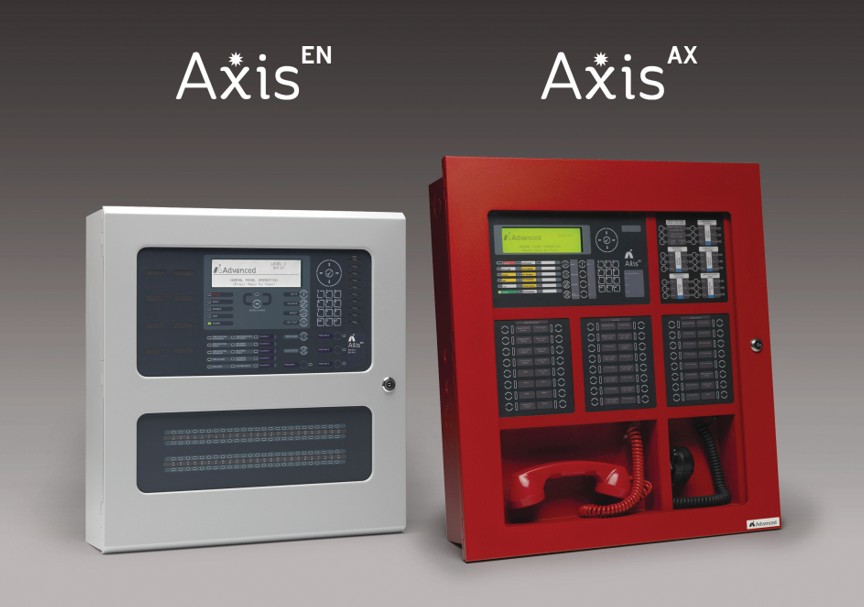
Fire systems must be effective from day one, yet capable of supporting future expansion without requiring redesign. As a result, the design approach is shifting away from isolated, building-specific systems towards scalable, networked fire systems that can evolve alongside the development itself. Advanced’s Axis AX supports this approach, allowing additional panels to be integrated without disrupting existing infrastructure.
A Shift Towards Network-Based Strategies
To meet these requirements, networked fire systems are becoming the standard for large-scale projects. Rather than treating each building as a standalone entity, multiple panels can be connected into a single, integrated structure. This enables consistent monitoring and coordinated response across an entire site, even as it grows. As new phases are completed, additional panels can be incorporated into the existing network, maintaining continuity and avoiding unnecessary complexity.
However, scalability must be matched by performance. As networks expand, systems must maintain consistent response times and reliable communication. High-capacity fire systems such as Axis AX, which support large-scale networked systems, allow developments to scale significantly without loss of performance, ensuring that growth does not compromise system effectiveness.
Building Resilience Into the Network
Resilience is a defining requirement in large-scale fire system design. Increasingly, this is achieved through distributed, peer-to-peer architectures, where each panel operates independently while remaining part of a wider network.
This approach removes reliance on a single central point of control. If one part of the system is compromised, the rest can continue to operate, maintaining critical detection and alarm functionality across the site. Failsafe operation is also essential. In the event of a loss of a central command function, systems must still support effective emergency response. These characteristics are particularly important in phased developments, where systems grow incrementally but must remain dependable throughout.
Managing Complexity Across Phases
As developments expand, so too does the complexity of fire safety management. Large sites often combine residential, commercial, and public environments, each with distinct operational requirements. Sectoring allows different areas to be managed independently while still forming part of a unified system. This supports tailored evacuation strategies and area-specific responses without affecting the wider network.
Phased construction also introduces challenges around commissioning and maintenance. With parts of a site occupied while others are still under development, systems must remain operational at all times. The ability to isolate sections of a network for testing ensures that work can be carried out without disrupting live areas.
The Importance of Central Visibility
While distributed operation improves resilience, centralized oversight remains essential. A graphical command interface allows operators to monitor system status, alarms, and faults across an entire development in real time.
This level of visibility becomes increasingly important as projects grow. In large, multi-phase environments, operators must be able to quickly identify and respond to issues, regardless of where they occur.
With networked fire systems such as Axis AX and Axis EN, large numbers of panels can be monitored from a single location, ensuring that even complex developments remain manageable in both day-to-day operation and emergency scenarios.
Flexibility Across Different Standards
Across the region, developments may be delivered to different regulatory frameworks depending on location and project requirements. While some follow UL-based standards, others are designed around EN requirements. Despite these differences, the underlying needs remain consistent. Systems must be scalable, flexible, and capable of maintaining performance as they expand. Solutions such as Axis AX and Axis EN are designed with this in mind, providing a consistent approach across different fire system standards while supporting long-term system growth.
Designing for Long-Term Performance
For consultants and developers, the focus is shifting from short-term compliance towards long-term performance. Fire systems must be selected based on their ability to evolve, rather than simply meeting the needs of a single phase. This includes ensuring that systems can scale without redesign, maintain performance as they expand, and integrate new elements over time. Systems that offer this level of flexibility provide a clear advantage in phased developments, where future requirements are often uncertain.
Supporting Safer Growth
As construction across the Middle East continues to push the boundaries of scale and complexity, fire systems must keep pace. Designing for phased delivery is now a fundamental requirement rather than an exception.
By adopting networked fire systems that combine scalability, resilience, and visibility, developers can ensure that fire protection remains effective throughout the lifecycle of a project. Networked fire systems such as Axis AX, alongside EN-based solutions like Axis EN where required, demonstrate how this can be achieved in practice.
Designing for phased delivery is now a fundamental requirement in the Middle East. By adopting networked fire systems that combine scalability, resilience, and visibility, developers can ensure that fire protection remains effective throughout the lifecycle of a project.
In doing so, they provide a foundation for long-term safety, supporting the continued growth of some of the world’s most ambitious developments.