Tabbara: The Accountability Gap in Distribution
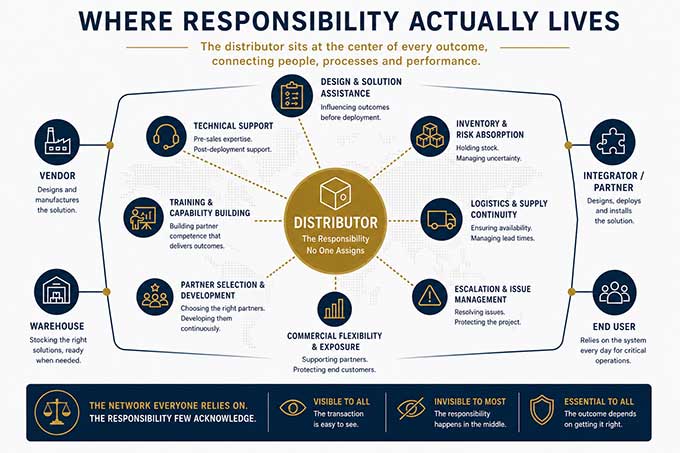
For decades, distribution has been measured by inventory levels, logistics efficiency, and commercial performance. Those metrics remain important, but they do not tell the full story. The real value of distribution is found in the quality of the partners it develops, the risks it absorbs, and the expertise it contributes
By: Loubna Tabbara, Marketing and Sales Director, Tabbara Electronics ; E-mail: pr@tabbara-electronics.com
In critical communications, accountability appears straightforward. When a system fails, the investigation moves in two directions: toward the vendor whose product did not perform, and toward the integrator whose deployment fell short. Between them sits the distributor, influencing decisions long before deployment and supporting outcomes long after handover, yet rarely assigned formal responsibility for either. That is the accountability gap in distribution.
What the Distributor Sees, and What That Demands
The distributor’s involvement in a project begins earlier than most parties assume. It starts at requirement drafting, where product selection is often shaped before a formal specification exists. It continues through design, supply, logistics, and the technical support that keeps deployments on track when conditions change. Across that entire arc, the distributor accumulates a picture that no single party — vendor, integrator, or end customer — holds in full.
That picture includes the partner landscape. A distributor working across a region over time knows which partners have genuine technical depth and which ones have learned to win without it. Some compete on price alone. Others win by promising end customers outcomes the project cannot realistically deliver. The distributor may or may not be in a position to change that outcome.
What does not change is who ends up living with it. The end user made their selection on the information available to them. When execution falls short, they are the ones managing an underperforming system, and the distributor who knows the ecosystem best is the one they turn to. That is not a complaint. It is a description of the responsibility that comes with the position.
The Middle Position
When execution breaks down, accountability follows the contract. The vendor defends the product. The integrator defends the installation. The distributor is rarely called into that room. On the surface, that looks like insulation from consequence. In practice, it is the opposite.
While the formal review is happening, the distributor is already working. Replacement stock is moving. Technical escalations are being managed. Partners are being supported through situations they were not fully prepared for. The project survives not because the post-mortem identified the right lessons, but because someone outside that room made sure there was no need for one. That is not a peripheral role. It is the role.
Inventory Is Not a Logistics Decision
Holding stock in a region like the Middle East is expensive. Warehouse space, tied-up capital, the discipline to maintain availability across a wide portfolio — none of it is passive. Most distributors in this market operate on a lean model. They order when the project is confirmed and manage lead times as a commercial variable.
In mission-critical communications, that model is a liability dressed as efficiency. A radio network that goes down while replacement units are in transit is not a supply chain problem. It is an operational failure with real consequences for the people depending on that network. The distributor who carries inventory is making a different calculation. They are absorbing financial exposure so that their partners and end customers do not absorb operational exposure. That is a risk transfer decision, not a warehousing decision.
The Partner Is the Product
End customers in this space buy brands they recognize and trust. What they receive is shaped almost entirely by who deploys the system. The brand’s reputation is built at the factory. It is sustained or damaged in the field, by the partner the distributor put there.
A distributor with a weak partner network is selling a promise they cannot keep. The product may be exceptional. The outcome will reflect the partner’s capability, not the product’s. Selecting, training, and continuously developing that network is not a channel management function. It is the distributor’s most direct influence over whether the end customer’s system performs as expected.
The Tabbara Position
The market is asking different questions now. Vendors are becoming more selective about who carries their brands because they understand that distribution quality shapes field outcomes. End customers are more informed, less forgiving, and far less likely to offer a second opportunity when the first deployment falls short. The partners that continue to grow are those with genuine technical capability, not simply competitive pricing.
In this environment, the distributor’s role is not shrinking. It is becoming more visible. The responsibility has always been there; the industry is only now beginning to recognize it.
For decades, distribution has been measured by inventory levels, logistics efficiency, and commercial performance. Those metrics remain important, but they do not tell the full story. The real value of distribution is found in the quality of the partners it develops, the risks it absorbs, the expertise it contributes, and ultimately the outcomes it helps create.
The industry may continue to measure distributors by logistics. The market increasingly measures them by outcomes. That is where Tabbara has always stood.