AI Fraud Fuels $129B Detection Market by 2033

The global fraud detection and prevention market reached $35.3 billion in 2025. Every new layer of financial services, from mobile banking to embedded finance, expands the attack surface. Classic rule-based security systems are no longer sufficient to cover it.
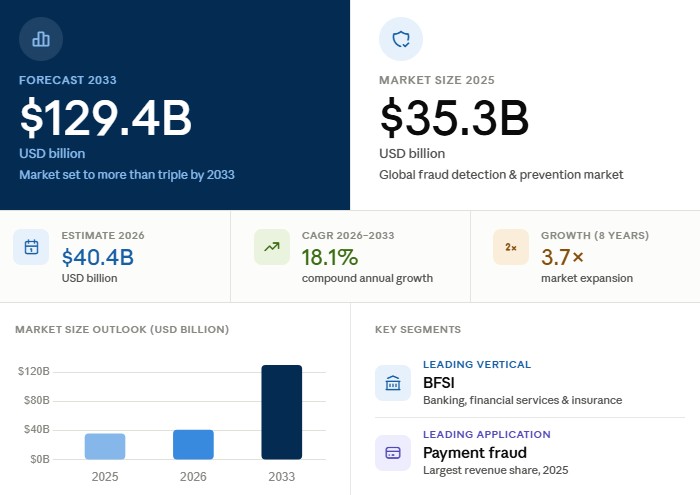
Grand View Research estimates the global fraud detection and prevention market reached $35.3 billion in 2025. Projections for 2033 stand at $129.4 billion, at a compound annual growth rate of 18.1 percent. The dominant vertical segment remains BFSI (banking, financial services, and insurance), which holds the largest market share. By threat type, payment fraud accounts for the largest revenue share, while identity theft is projected as the fastest-growing segment through 2033. Solutions account for 63.1% of the total market, as opposed to services.
Demand Also Driven by Regulation and Infrastructure
Growth is not simply a response to rising online transaction volumes – it is structural. Embedded finance integrates financial services into non-bank ecosystems, from e-commerce platforms to telecom operators, multiplying the number of points where fraud can occur. Real-time payment networks eliminate the time window that previously allowed post-transaction detection.
Digital identity infrastructure, such as biometrics, eKYC, decentralized identity, is becoming a critical component of the onboarding chain, and an increasingly attractive target. In parallel, regulatory frameworks including AML, KYC, PSD2, and GDPR are compelling institutions to implement standardized, auditable security processes, directly stimulating investment in specialized solutions.
AI Is Now a Standard Fraud Tool
More than 50% of modern fraud incidents involve AI-enabled manipulation. Attackers use voice cloning to spoof authorization calls. AI-generated phishing campaigns deliver personalized content in real time. Deepfake onboarding bypasses biometric identity verification. Synthetic identities combine real and fabricated data to pass KYC checks. None of this requires sophisticated actors. Fraud-as-a-service networks make these tools widely available, and the entry threshold has dropped significantly.
Source: Grand View Research, 2025
The Gulf Is a Growing Target
The report does not segment MENA separately. But the dynamics it describes for fast-growing emerging markets map directly onto the GCC region. Gulf states are building national digital identity infrastructures and real-time payment networks at speed. That investment creates opportunity. It also creates exposure. The region’s fraud detection spending will follow the same trajectory as Asia Pacific and Latin America, which the report identifies as the fastest-growing markets globally.
Defense Is No Longer Enough
The market expanding from $35 to $129 billion in eight years is a measured response to systemic risk. The security industry is shifting from reactive to predictive. AI, behavioral biometrics, and real-time scoring are becoming infrastructure. Institutions that do not treat this as an operational priority are not only falling behind technologically. They are becoming easier targets.