The Next Step in Correctional X-Ray Security
The philosophy behind correctional screening technology is changing. For many years, innovation focused mainly on image quality, penetration capability, and hardware performance. The next stage of correctional screening will be defined by how effectively technology converts scan data into actionable visual evidence.
By: Igor Bondarev, Director, LINEV Systems
E-mail: bondarev@linevsystems.com
Correctional security has always adapted to one persistent reality: concealment methods change faster than routine procedures. Every decade brings new forms of contraband, new ways to hide it, and new operational pressure on correctional staff. Metal detectors once represented a major step forward for inmate intake and visitor control. Later, low-dose X-ray body screening introduced something fundamentally different: the ability to detect not only metallic threats but also objects hidden under clothing or concealed inside the human body.
The Operator Challenge
That shift changed correctional screening permanently. Yet another challenge emerged alongside improved detection capability. The issue was no longer simply whether a scanner could produce a useful image. The issue became what happened after the image appeared on the screen.
In busy correctional environments, operators work under time pressure. Intake areas become congested. Staff turnover creates uneven experience levels. Large numbers of scans must be assessed quickly and consistently across multiple shifts. In practice, the effectiveness of a screening checkpoint depends not only on imaging technology but also on how clearly the system supports the operator’s decision.
For years, this burden was treated as part of the job. A skilled operator was expected to examine a full-body X-ray image, identify suspicious areas, judge their relevance, and determine whether secondary inspection or escalation was necessary.
Presenting Information More Intelligently
New-generation LINEV Systems correctional X-ray scanners are moving body screening beyond routine full-image interpretation and toward evidence-based operator review. The purpose is not to replace correctional officers or remove human decision-making from the process. The purpose is to restructure how information is presented to the operator.
Rather than asking staff to continuously interpret complete radiographic images, modern AI-assisted screening systems can identify suspicious regions during the scan itself. The operator is then presented with localized visual evidence associated with the area of concern. The operator still makes the final decision, but the review becomes faster, more structured, and less dependent on radiology-style interpretation skills.
The practical implications are significant for correctional facilities. At intake checkpoints, delays create more than inconvenience. Congestion affects movement control, staffing allocation, and overall facility stability. Large institutions may process hundreds of individuals through screening points within short operational windows. Under these conditions, even small reductions in review time can improve checkpoint flow and staff efficiency.
Advanced Screening for Correctional Facilities
Modern correctional X-ray platforms such as CLEARPASS and CLEARPASS Ci show how low-dose penetrating X-ray screening can be integrated into real correctional operations. These systems support the detection of internally and externally concealed contraband while maintaining rapid screening workflows suitable for secure facilities. At the same time, newer software architectures are reshaping how operators interact with screening data.
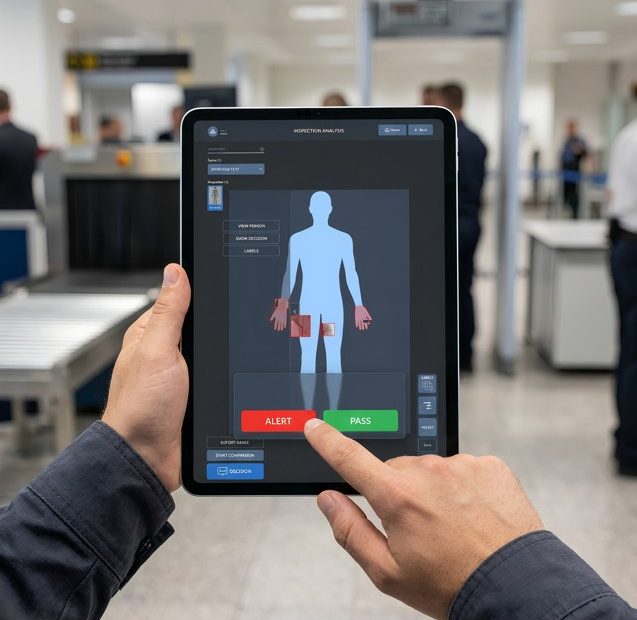
One important part of this transition is the visual evidence presentation. In many airport-style screening systems, operators see abstract alert zones on generic avatars or standardized body outlines. That approach may fit aviation workflows, but correctional environments often require more operational context because the detection task is different. Internally concealed contraband, body-carried narcotics, non-metallic weapons, miniature electronics, and improvised concealment methods require penetrating X-ray capability combined with clear, localized evidence.
As a result, new correctional screening platforms are moving toward real-body representation combined with localized evidentiary imaging. Instead of presenting only a general alert area, the system provides focused X-ray-based evidence linked to the suspicious region.
Privacy Expectations and Consistency
Privacy expectations are also influencing system design. Historically, discussions around X-ray body screening often focused on whether full-body imaging itself created operational or ethical concerns. Evidence-based review changes this discussion. By directing attention primarily toward suspicious regions and localized evidence, modern systems can reduce the need for routine full-body image interpretation while preserving the detection advantages of penetrating X-ray technology. The result is not the removal of human review, but a narrower and more operationally focused form of review.
Consistency is another major factor. In traditional operator-driven screening, performance can vary depending on experience, fatigue, training quality, and workload. Evidence-based screening architectures help reduce this variation by structuring the process around prioritized findings. Facilities still need trained staff and clear procedures, but the screening task becomes more standardized and repeatable.
A New Philosophy of Correctional Screening
Hardware design is also changing how these systems can be deployed. Newer correctional X-ray systems increasingly use compact footprints, open inspection layouts, and wheelchair-accessible screening spaces designed for real correctional handling rather than airport passenger flow.
At the same time, advances in detector technology and real-time data processing are changing expectations around throughput. Faster detector analysis, automated suspicious-region identification, and simplified operator interfaces allow modern systems to maintain rapid screening rates without turning the checkpoint into a radiographic interpretation station.
Perhaps most importantly, the philosophy behind correctional screening technology is changing. For many years, innovation focused mainly on image quality, penetration capability, and hardware performance. Those characteristics remain critical, but they no longer define the full operational value of the system.
The next stage of correctional screening will be defined by how effectively technology converts scan data into actionable visual evidence.
This transition reflects a broader change across security technology. Artificial intelligence in correctional screening is no longer only a detection tool. Increasingly, it functions as a decision-support layer that organizes operator attention, prioritizes findings, and helps officers act faster and more consistently.
For correctional agencies, this may become the most important development of all. The future of people screening will not be defined simply by seeing more. It will be defined by helping officers make faster, clearer, and more confident decisions based on evidence they can use.