Hytera: Building the Communication Backbone of Smart and Safe Cities
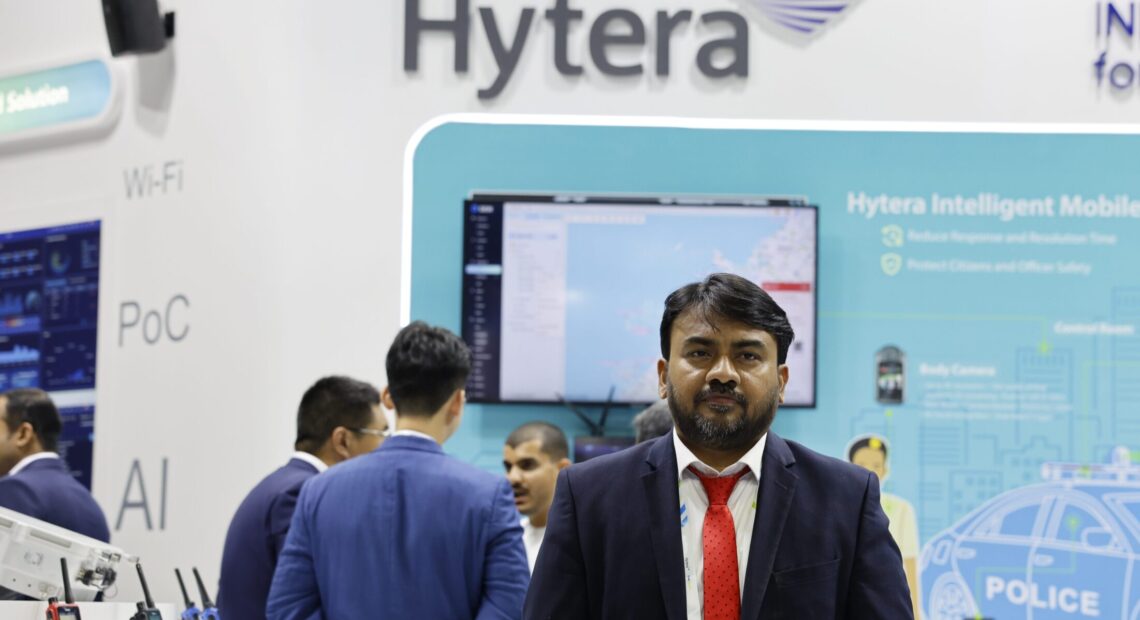
During GITEX Global 2025 in Dubai, a&s Middle East sat down with Yasser Arafath, Regional Sales Manager for the Middle East and Africa at Hytera Dubai Office, to discuss the company’s latest innovations, its vision for AI-driven communications, and its growing role in the region’s digital transformation.
By: Orhan Hadžagić
a&s Middle East: GITEX Global 2025 has once again gathered technology leaders from around the world. What are Hytera’s main goals and expectations from this year’s participation?
Arafath: GITEX is more than just a trade show; it’s where vision meets impact. This year, Hytera comes with a clear ambition to unveil the next generation of unified, AI-infused communication solutions for mission-critical ecosystems. Our goal is to strengthen strategic partnerships, secure new contracts, and position Hytera at the center of digital transformation discussions across the region. We also see GITEX as an opportunity to gather direct feedback from customers on the ground, ensuring our innovations remain relevant, agile, and impactful.
a&s Middle East: What are the key products or projects Hytera is unveiling this year?
Arafath: In 2025, we’re unveiling an exciting portfolio of next-generation solutions that bring together AI-powered voice, video, and data for smarter, safer operations. For example, the Hytera P60 Smart PoC radio is a compact, multifunctional device offering Push-to-Talk over Cellular (PoC) and full compatibility with 3GPP standards. It also features a built-in body camera that stores video locally at the press of a single button. This PoC radio integrates seamlessly with both our Digital Evidence Management (DEM) system and Evidence Management System. Another highlight is the Hytera SC700 LTE body camera, purpose-built for 24/7 operations. It includes a high-capacity, non-removable battery and supports HD and 2K video recording. Integrated with our digital evidence system, it enables efficient, secure access to data for frontline officers. Finally, our Intelligent Mobile Enforcement Solution combines body-worn cameras, in-vehicle video, and AI-driven real-time monitoring with facial and license-plate recognition; enhancing situational awareness and response efficiency.
We’re not just embedding AI into devices; we’re building unified platforms where radios, cameras, and command centers interoperate seamlessly.
Arafath:”We also see GITEX as an opportunity to gather direct feedback from customers on the ground, ensuring our innovations remain relevant, agile, and impactful”.
a&s Middle East: The telecommunications industry is rapidly evolving with AI, IoT, and 5G. How does Hytera stay ahead of these technological shifts?
Arafath: Innovation is part of our DNA. Our regional R&D teams continuously invest in merging AI, IoT, and 5G across every layer of our product architecture. We’re not just embedding AI into devices; we’re building unified platforms where radios, cameras, and command centers interoperate seamlessly. We also run pilot projects with end users to test innovations in real-world conditions and refine them through continuous feedback.
a&s Middle East: What are the biggest challenges Hytera faces in the Middle East and North Africa, and how do you address them?
Arafath: We face three key challenges in this region. The first is regulatory complexity; each country has its own public safety and communications regulations, so we work closely with local partners to ensure full compliance. The second is security: every system we build incorporates AES-256 encryption across TETRA, DMR, and LTE technologies. The third involves procurement for mega projects; when customers transition from existing systems to new technologies, we ensure smooth migration by maintaining interoperability with their current infrastructure. By combining global technological strength with a deep understanding of local needs, we effectively address these challenges.
a&s Middle East: Hytera serves both public safety and enterprise sectors. How do you balance these two segments?
Arafath: We don’t see them as separate silos; they’re two ends of the same spectrum. Public safety agencies require rugged, ultra-reliable systems, while enterprises seek scalability and seamless integration. For public safety, trends include the convergence of narrowband and broadband networks enhanced by AI analytics; for enterprises, IoT-based workplace safety and unified communication are key drivers. Our unified platform allows us to tailor and customize solutions for both sectors.
a&s Middle East: The MENA region is heavily investing in smart cities and digital transformation. How is Hytera positioning itself in these initiatives?
Arafath: Hytera aims to be the communication backbone of smart cities. We align our roadmap with national digital transformation visions by offering integrated command centers, AI-driven real-time alerts, and converged communications across domains; from traffic management to emergency services, transportation, and utilities. Our solutions connect with nationwide control systems, enhancing interoperability and resilience.
a&s Middle East: As a seasoned sales leader with over 15 years in telecommunications, what major shifts have you observed in customer expectations?
Arafath: A decade ago, customers simply wanted hardware that worked. Today, they expect intelligence, continuity, and measurable outcomes. They want systems that detect threats, generate AI-based insights, and integrate directly into command centers. Our success comes from evolving with these expectations; offering not just devices but intelligent, responsive ecosystems.
One key project is the 9-1-1 National Command and Control Center in Iraq, a 300-seat facility integrating voice, video, and data for nationwide emergency response and smart city operations.
a&s Middle East: Many of your clients rely on Hytera for mission-critical communications. How does the company ensure compliance with evolving professional and private network standards across different markets?
Arafath: Compliance is one of our core pillars. We strictly follow ETSI, ISO, and 3GPP international standards. For DMR and TETRA technologies, we adhere to ETSI guidelines; for LTE, we comply with 3GPP standards, including all relevant tests. We also ensure alignment with local regulations; for example, in the UAE, we comply with ADNOC’s ECA standards.
a&s Middle East: Could you highlight some major clients or landmark projects that demonstrate Hytera’s regional expertise?
Arafath: We serve numerous public safety customers, though some cannot be publicly named. One key project is the 9-1-1 National Command and Control Center in Iraq, a 300-seat facility integrating voice, video, and data for nationwide emergency response and smart city operations. In the UAE, we support multiple public safety organizations with broadband and narrowband radios, dual-mode systems, and body-worn cameras; strengthening interoperability and efficiency in mission-critical communications.
a&s Middle East: Finally, what are Hytera’s strategic priorities for 2026 and beyond?
Arafath: Our roadmap is built on three pillars:
- Innovation – continuously launching AI-driven technologies aligned with market needs.
- Regional Growth – expanding our presence through local hubs and direct engagement with end users.
- Sustainability – focusing on greener, energy-efficient hardware and ecosystem solutions.
These pillars will guide Hytera into 2026 and beyond as we help nations build safer, stronger, and more connected societies.
Regional Growth – expanding our presence through local hubs and direct engagement with end users.