Middle East Data Breach Costs Reach $8M in 2026

AI-enabled attacks accounted for 26% of malicious breaches, while extensive use of AI and security automation reduced average breach costs by more than $3 million.
The average cost of a data breach for organizations in the Middle East reached $8 million in 2026, according to IBM’s 2026 Cost of a Data Breach Report, with AI increasingly influencing both cyberattacks and organizations’ ability to contain their financial impact.
Among malicious breaches analyzed in the region, 26% were AI-enabled, while another 11% of organizations were unable to determine whether attackers had used AI.
At the same time, organizations making extensive use of AI and security automation recorded average breach costs more than $3 million lower than organizations that had not deployed these capabilities. However, 23% of surveyed organizations had still not adopted them.
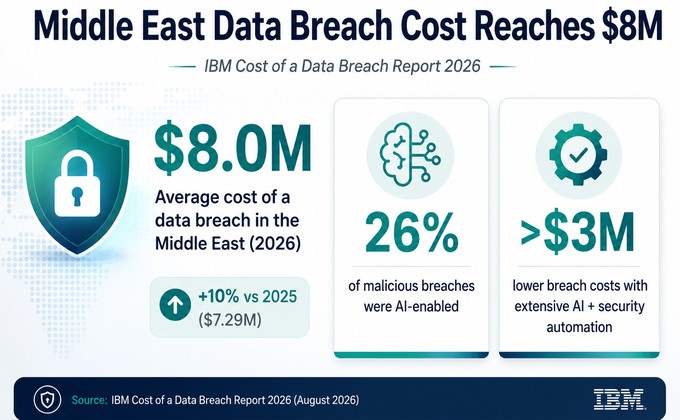
IBM found that the average Middle East data breach cost reached $8 million, while extensive AI and security automation reduced costs by more than $3 million.
Financial and technology sectors face highest costs
Lost business remained the largest component of breach costs in the Middle East, averaging $3.57 million per incident, followed by post-breach response at $2.17 million, detection and escalation at $1.9 million, and notification costs at $360,000.
Financial services and technology organizations recorded the highest average breach costs at $10.67 million each, followed by the industrial sector at $9.6 million.
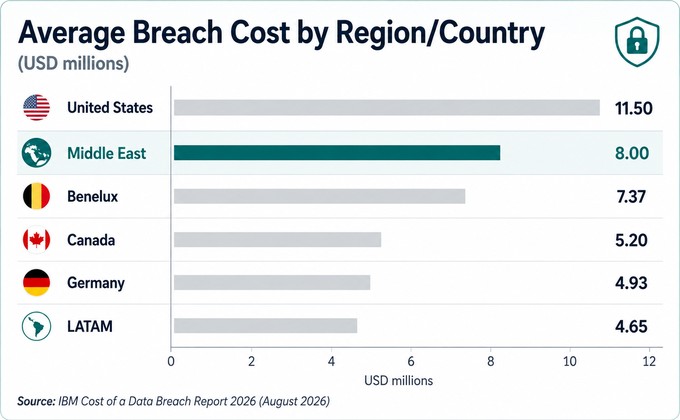
The Middle East recorded an average data breach cost of $8 million in 2026, among the highest levels globally.
Phishing remains the leading breach vector
Phishing, including voice and SMS phishing, was the most common initial breach vector, accounting for 18% of incidents and carrying an average cost of $10.41 million. Supply chain compromise and social engineering each accounted for 16%.
IBM identified mismanaged secrets and keys, excessive privileges and poor role management, and an inability to prioritize threats as the three leading factors increasing breach costs. Encryption, DevSecOps practices, and endpoint detection and response were among the factors associated with lower costs.
Following a breach, 59% of surveyed Middle East organizations planned to increase cybersecurity investment, with identity and access management the most common priority.
The report was conducted by the Ponemon Institute and sponsored and analyzed by IBM. It examined breaches experienced by 602 organizations globally between March 2025 and February 2026, including organizations in Saudi Arabia and the UAE.