FBI Uses Twin Data to Test AI Facial Recognition
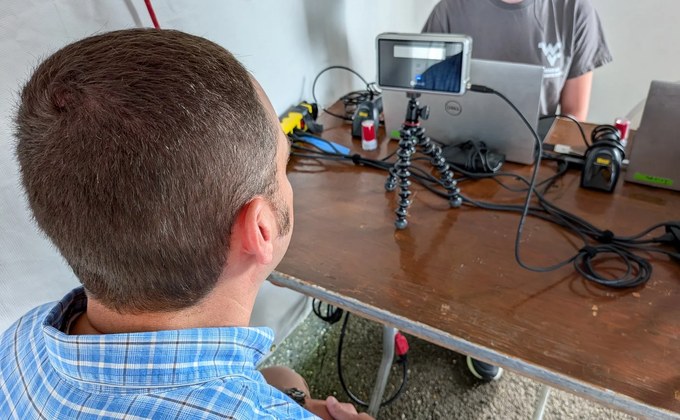
Photo: FBI
The FBI is using biometric data collected from participants at the 2026 Twins Days Festival to evaluate how well AI-powered facial recognition systems can distinguish between identical twins — one of the most difficult challenges in biometric identification.
Every August, thousands of twins descend on Twinsburg, Ohio, for a festival that is part family reunion, part scientific laboratory for some of the FBI’s most demanding biometric research. The FBI said its long-running research partnership with West Virginia University (WVU) continues to provide a rare dataset covering facial, fingerprint and iris biometrics, allowing researchers to test emerging algorithms and better understand their limitations.
For more than 15 years, researchers have collected biometric data from festival volunteers. Because many participants return over multiple years, the project also provides longitudinal data that can be used to examine how biometric characteristics and recognition performance change as people age.
Identical twins present a particularly demanding test for facial recognition because their facial characteristics can be extremely similar. Their fingerprints and iris patterns, however, remain unique, giving researchers an opportunity to compare different biometric modalities under unusually challenging conditions.
“From a biometrics perspective, identical twins are the ultimate challenge because we are trying to uniquely identify one person from another,” said Ben Smith, a biometric program manager in the FBI’s Criminal Justice Information Services Division.
Testing the limits of AI biometrics
The research has become increasingly relevant as artificial intelligence plays a larger role in biometric recognition. Instead of testing facial recognition systems only against unrelated individuals, the twin dataset allows researchers to evaluate algorithms against people with naturally occurring, highly similar facial features.
Jeremy Dawson, a professor in WVU’s Department of Computer Science and Engineering who leads the study, said large and diverse datasets are essential for developing and evaluating AI-based neural networks.
The FBI says even the best current facial recognition algorithms still have limitations when attempting to distinguish identical twins. That has practical implications for forensic work, particularly when investigators have only an image and no additional biographical information with which to confirm an identity.
The findings help the Bureau assess new biometric tools before operational use and establish where algorithmic results require additional expert analysis or corroborating evidence.
According to the FBI, participation in the Twins Days research is voluntary. Biometric information provided to the Bureau is anonymized, kept separate from operational FBI systems and used solely for research.