ScreenCheck: Connected Security Ecosystems Redefining Residential Environments

The global access control and residential security market, projected to exceed USD 25 billion by the mid-2030s, is driven by rapid urbanization, smart city initiatives, and rising expectations for connected living. As residential developments grow in scale and complexity, security is no longer viewed as a collection of independent systems. Integration, automation, and intelligence have become foundational requirements.
By: Mohamed Zakky, Sales Director, ScreenCheck
mohamed.zakky@centena.com
Modern residential environments now function as interconnected communities, comprising multiple towers, shared amenities, parking infrastructure, visitor flows, service access, and increasingly mobile residents. Within these environments, security extends well beyond door control. It encompasses access control, intercom communication, video surveillance, fire alarm systems, public address and emergency alerting, vehicle access, and digital visitor workflows. Effectiveness is no longer measured by how many entry points are secured, but by how seamlessly these systems operate together, supporting safety and daily life without disruption.
The Operational Advantages of Interconnected Residential Security
Traditional residential security deployments evolved incrementally. Intercoms, access readers, CCTV systems, fire alarms, and parking controls were often implemented at different times, by different vendors, and across separate platforms. While functional, these siloed systems introduce operational friction, inconsistent user experiences, and increased management overhead.
By orchestrating different technologies into a cohesive architecture, ScreenCheck helps residential communities move beyond traditional security toward connected living environments where safety, communication, and daily operations work together seamlessly.
Industry research referenced by analysts such as Grand View Research and Precedence Research shows that fragmented security environments increase administrative workload and slow response times. In contrast, residential operators adopting integrated security platforms consistently report faster incident response, reduced manual intervention, and lower operational costs related to access provisioning, visitor processing, and compliance reporting. In an interconnected residential ecosystem, identity management, access control, intercom communication, video verification, fire detection, public address, and automation operate as a single workflow.
Resident onboarding becomes digital and immediate. Mobile credentials replace physical cards, allowing seamless movement across entrances, parking areas, gyms, pools, and shared amenities. Visitors receive temporary access before arrival, validated in real time through integrated intercom and video systems. Check-in times are reduced, staff workloads decrease, and full audit trails are generated automatically.
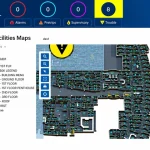
Unified dashboards combining access, video, alarms, and audio communication have been shown to reduce incident resolution times by up to 40–50 per cent, particularly in high-density residential environments where response speed and coordination are critical.
The ScreenCheck Perspective on Residential Security Integration
 Rather than approaching residential security as a collection of individual products, ScreenCheck’s philosophy centers on how technologies function together within real, high-density living environments. The focus is on integration, operational continuity, and long-term adaptability, ensuring that security supports daily life without adding friction.
This ecosystem-driven approach recognizes that modern residential communities require consistent policies, centralized visibility, and coordinated response across towers, amenities, and shared infrastructure. Security is treated not as a standalone layer, but as an operational foundation that quietly enables movement, communication, and safety across the community.
Strengthening the Ecosystem Through Strategic Partnerships
As residential security ecosystems mature, communication and alerting play an increasingly critical role alongside access and surveillance. ScreenCheck’s strategic partnership with BAS-IP significantly expands the depth and capability of its residential security architecture.
BAS-IP, a European leader in IP video intercom and access intercom solutions, extends access control into the resident experience itself. Integrated intercom platforms allow residents to see, communicate with, and authorize visitors remotely through mobile devices, while maintaining consistent access policies across multiple buildings and entry points. BAS-IP’s link platform allows seamless integration of intercoms with other systems like building management, video surveillance, home automation, etc.
Together with access control, video surveillance, vehicle entry systems, and fire alarm integration, these technologies form a unified residential security ecosystem. Fire alarms, intercoms, public address, video, and access control no longer operate in isolation, but as coordinated components within a single operational framework.
This level of integration enables residential operators to manage thousands of users across multi-tower environments from a central platform, reduce manual intervention, and maintain consistent security and communication standards at scale. Importantly, modernization can occur progressively, retaining existing infrastructure while introducing mobile credentials, unified platforms, and integrated communication layers over time.
By orchestrating these technologies into a cohesive architecture, ScreenCheck helps residential communities move beyond traditional security toward connected living environments where safety, communication, and daily operations work together seamlessly.