Dubai Police unveils “Digital Twin” capability to reconstruct crime scenes
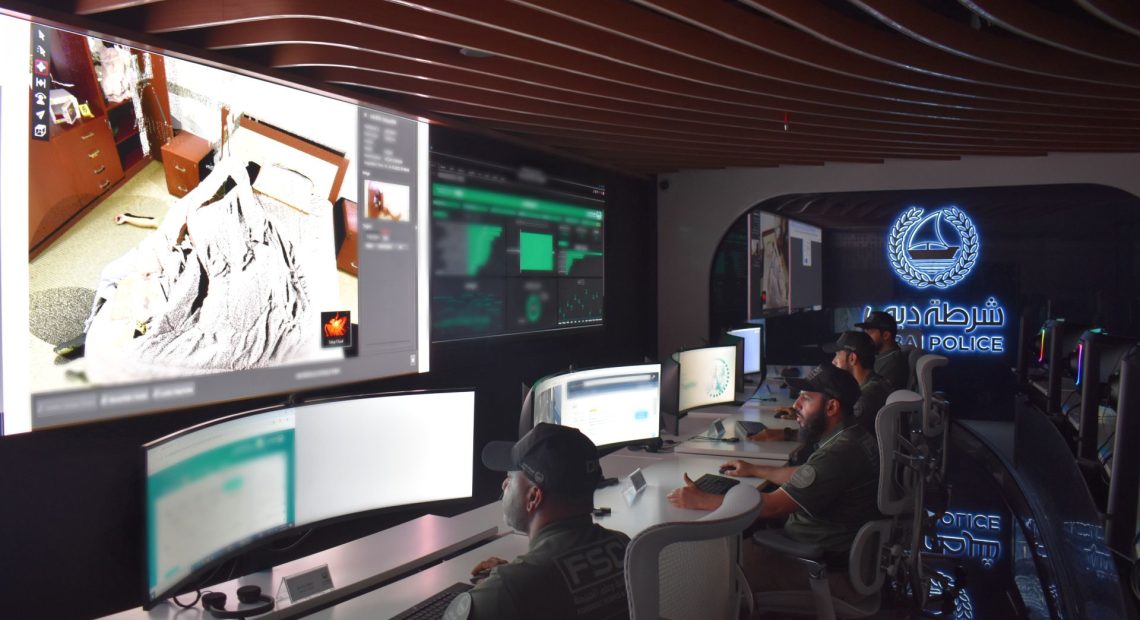
Dubai Police has introduced a pioneering Digital Twin system that allows crime scenes to be rebuilt virtually with remarkable scientific accuracy, marking a major leap in smart criminal investigatios
The innovative platform recreates crime scenes digitally using virtual reality and highly detailed three-dimensional models. Investigators can walk through the scene virtually, examine evidence from every angle, and reconstruct events with precision. This approach enables faster analysis, stronger evidence verification, and greater confidence in forensic findings presented in court.
At the heart of the system is its ability to integrate all physical traces into a single, comprehensive analytical model. Officers can return to the crime scene digitally at any time, review evidence in detail, and test different scenarios without physically revisiting the location. The interactive models are transparent, auditable, and support data-driven decision making, enhancing the credibility and judicial acceptance of forensic evidence.
“Dubai Police remains committed to strengthening criminal investigations through advanced digital systems,”
Brigadier Engineer Senior Expert Rashid Ahmed Lootah, Acting Director of the General Department of Forensic Evidence and Criminology
The Digital Twin operates through three key stages. First, complete digital documentation of the crime scene. This is followed by data enhancement and refinement. Finally, advanced analysis produces intelligent outputs. The system combines three-dimensional scanning, data analytics, and artificial intelligence to reconstruct complex incidents and predict potential event sequences. It is also designed to integrate seamlessly with command-and-control platforms.
The project has earned prestigious recognition. It received a 7 Star rating and was named Best Innovative Project at the International Best Practices Competition IBPC 2025. It also won the UAE Ideas Award 2025 in the Smart Government and Digital Transformation category, underlining its alignment with innovation, sustainability, and forward-looking governance.
Brigadier Engineer Senior Expert Rashid Ahmed Lootah, Acting Director of the General Department of Forensic Evidence and Criminology, said Dubai Police remains committed to strengthening criminal investigations through advanced digital systems. He stressed that investing in innovation and empowering national expertise with the latest global technologies is essential to raising investigative standards and supporting a safer city.
Lieutenant Colonel Expert Dr. Engineer Mohammad Ali Al Qasim, Head of the Forensic Engineering Section at the Department of Specialised Forensic Evidence, explained that the system has fundamentally changed how crime scenes are analysed. By digitally reconstructing scenes and integrating all evidence into a single model, investigators can re-examine findings at any stage of the case without returning to the physical location. This has reduced margins of error, accelerated forensic work, and improved the accuracy of event reconstruction.
Engineer Expert Amna Al Mazmi, Project Manager of the Digital Twin initiative, revealed that the system has already helped clarify nearly 85 incidents.
In one case initially reported as a suicide, a delivery rider was said to have jumped from a bridge, based on a witness account. After applying the Digital Twin reconstruction and analysing the data, investigators discovered that the motorcycle had been struck from behind by another vehicle whose driver fled the scene. The impact caused the rider to fall from the bridge while the motorcycle remained above. The case was reclassified as a hit-and-run crime rather than a suicide.
In another incident involving the partial collapse of a parking basement, the Digital Twin provided clear scientific answers. Analysis showed that reinforced concrete elements had been repeatedly exposed to water leakage, affecting their structural properties. Through advanced modelling and load simulation, investigators identified changes in the thermal expansion and contraction behaviour of water-saturated concrete. This led to uneven stress distribution in the supporting columns and accelerated structural deterioration, ultimately resulting in the collapse.